A quick note before you read. This post is based on my personal experience working in HR and on publicly available research and data. It is not legal advice. If you ever believe you were treated unfairly in a hiring process, an employment attorney or the EEOC can help you understand your options.
If you have sent out application after application and heard nothing back, somebody has probably warned you about ATS rejecting your resume before a human ever sees it. Maybe it was a career coach. Maybe it was a video that popped up at midnight while you were refreshing your inbox. Either way, it planted a picture in your head of a cold little robot deleting your hard work in half a second.
I spent over 18 years in HR, and I have used these systems from the inside. So I want to answer the questions you are actually carrying about them, the way I would if we were sitting across from each other with coffee. Some of the answers will make you feel better. A couple of them will hand you real work to do. All of them are true.
Let’s Try To Answer Some Of Your QUESTIONS…
Is a robot really rejecting my resume before anyone sees it?
Mostly, no. An applicant tracking system, or ATS, is the software companies use to collect and organize applications. Think of it less like a bouncer and more like a very big filing cabinet with a search bar.
Resume Genius surveyed 1,000 U.S. hiring managers for its 2026 Hiring Insights Report. Of those managers, 71 percent said their company uses an ATS, but only 19 percent use AI to screen out applications before a human reviews them. Only 6 percent said the software moves candidates forward or rejects them with little human review. lenz
“71% of hiring managers say their company uses an ATS. Only 19% let AI screen applicants out before a person looks.”
There is one place where the system really can say no on its own, and that is the screening questions at the start of an application. If a job asks whether you are authorized to work in the U.S., whether you hold a required license, or whether you can work in a certain location, and your answer does not match, the system can filter you out automatically. In recruiter interviews done by the resume company Enhancv, the few recruiters who used automatic rejection used it only for dealbreakers like those. So answer those questions carefully and honestly. They are the real gate. geekwire
To be fair, not every survey agrees. MyPerfectResume found that 65 percent of hiring managers say AI rejects some applicants before a person sees them. The difference mostly comes down to what people mean by reject. Screening questions count. So does software that ranks applicants and pushes some of them to the bottom of a very long list. We will come back to that list in a minute, because it is the real story. myperfectresume
Where did that 75 percent number come from?
This is my favorite part, since it shows how far bad advice can travel. The claim that 75 percent of resumes are rejected by ATS before a human sees them traces back to a 2012 sales pitch from a company called Preptel, which sold resume optimization services. Career consultant Christine Assaf dug into it and found the number came with no study, no survey, and no context. Preptel closed in 2013. The statistic outlived the company and has been repeated in thousands of articles and videos ever since. theinterviewguys
That does not mean a person is reading every word of your resume. It means the scary version you heard was built to sell something. When a number makes you panic and then immediately offers you a product to calm the panic, it is fair to ask where that number came from. I would ask that about anything you read online, including career advice.
If it is not the software, why am I not hearing back?
There are so many of you, and so few of them. That is the honest answer, and it has nothing to do with your worth.
Greenhouse, one of the biggest hiring software companies, found that the average job drew 244 applications in 2025, up from 116 in 2022. The average recruiter handled 746 applications that year, compared with 146 in 2022. Recruiting teams got smaller while the pile got taller. usecarly
“244 applications per job in 2025, more than double the 116 per job in 2022.”
Picture what that means on a regular Tuesday afternoon. A recruiter opens a role with a couple hundred applications sitting in it. The system sorts them, usually by how closely each resume matches the job description. She starts at the top. Somewhere around the middle, her next meeting starts, or the hiring manager says the first five look great, and she stops. Nobody rejected the resumes at the bottom of that pile. Nobody ever got to them.
One recruiter in the Enhancv study said it plainly. “The ATS doesn’t reject resumes. People do.” rollingstone
That is why matching matters so much. When your resume uses the same language as the job posting, the system tends to rank you higher, and a higher spot means a human actually reaches you. When Resume Genius asked hiring managers why resumes got filtered out, the most common reasons were poor alignment with the job requirements, missing skills, and incomplete work histories. Every one of those is something you can work on tonight. workplacejournal
How long does a person actually spend on my resume?
Less time than you spent picking the font. The most quoted number comes from a 2018 eye tracking study by the job site Ladders, which found recruiters spent an average of 7.4 seconds on the first look at a resume. That study is several years old, and the exact number changes depending on who you ask, but newer research tells the same basic story. In a survey by Novoresume, 42 percent of HR professionals said they decide on a resume in under 10 seconds. csuglobal
Here is the part nobody tells you. That first glance is not a full read. It is a check. Does this person look like a fit, yes or no? If the answer is yes, she slows down and actually reads. If the answer is no, she moves on to the next one in the pile.
In the Ladders study, the resumes that struggled had cluttered layouts, very little white space, multiple columns, and long sentences. So make that first glance easy. Put your job titles where the eye naturally lands. Use clear section headings. Write short lines that start with what you did and end with what changed because you did it. If a stranger can tell what you do and how well you do it in the time it takes to sip your coffee, your resume is doing its job. hrdive
Should I use AI to write my resume, or will that hurt me?
Use it as your editor, not your author. That is the line hiring managers keep drawing.
Resume Genius surveyed 1,500 hiring managers for its 2026 Hiring Trends Report and found that application materials written mostly by AI are now the second biggest red flag they see, named by 49 percent of them. Only job hopping ranked higher. The irony is that 58 percent of those same hiring managers use AI to screen resumes themselves. cpapracticeadvisor
Robert Half surveyed more than 2,000 hiring managers and found out why they are so frustrated. In that survey, 67 percent said reviewing AI written applications has slowed down hiring, and 65 percent said resumes polished by AI have made it harder to tell what a candidate can really do. When every resume sounds the same, nobody stands out. deel
That does not mean you have to do everything the hard way. AI is great for tightening a clunky sentence, catching a typo, or helping you line up your wording with a job posting. Where it goes wrong is when it writes your experience for you. You end up with phrases like results driven professional and dynamic team player, which tell a hiring manager absolutely nothing. Sometimes it even adds things you never did, and that is a problem you do not want to explain in an interview. Your resume should sound like you on your best day, with real numbers and real results that only you can supply.
Can AI screening be unfair to women like me?
It can, and the courts are starting to take that seriously. In a lawsuit called Mobley v. Workday, an older Black job seeker alleges that the AI screening tools in Workday’s hiring software repeatedly filtered him out because of his race, age, and disability. In March 2026, a federal court rejected Workday’s argument that age discrimination law does not cover job applicants screened by its tools, and kept alive the claim that the software company itself could be held responsible. There has been no final ruling yet, so nobody knows how the case will end. Workday Loses Bid To Dismiss AI Hiring Bias Lawsuit Filed By Older Black Worker
I am telling you this because AI tools can pick up patterns from past hiring decisions, and past hiring decisions were not always fair to women, especially Black women and women over 40. You cannot control the software a company chooses. What you can control is giving that software, and the person behind it, a clear picture of your skills in the language of the job. If you ever believe you were screened out because of who you are rather than what you can do, keep a record of what you applied to and when, and reach out to an employment attorney or the EEOC.
This is what I would like for you to realize... The robot is not your enemy. The pile is. Your job is not to trick a computer. It is to make a busy person’s next ten seconds easy. Match the language of the posting. Make your titles and results easy to spot. Answer the screening questions with care. Let AI help you polish, and keep the story yours.
None of the silence you have been sitting in means you are not good enough. It means you are one of a couple hundred, and the system was built for speed, not kindness. You can work with that, and now you know how.
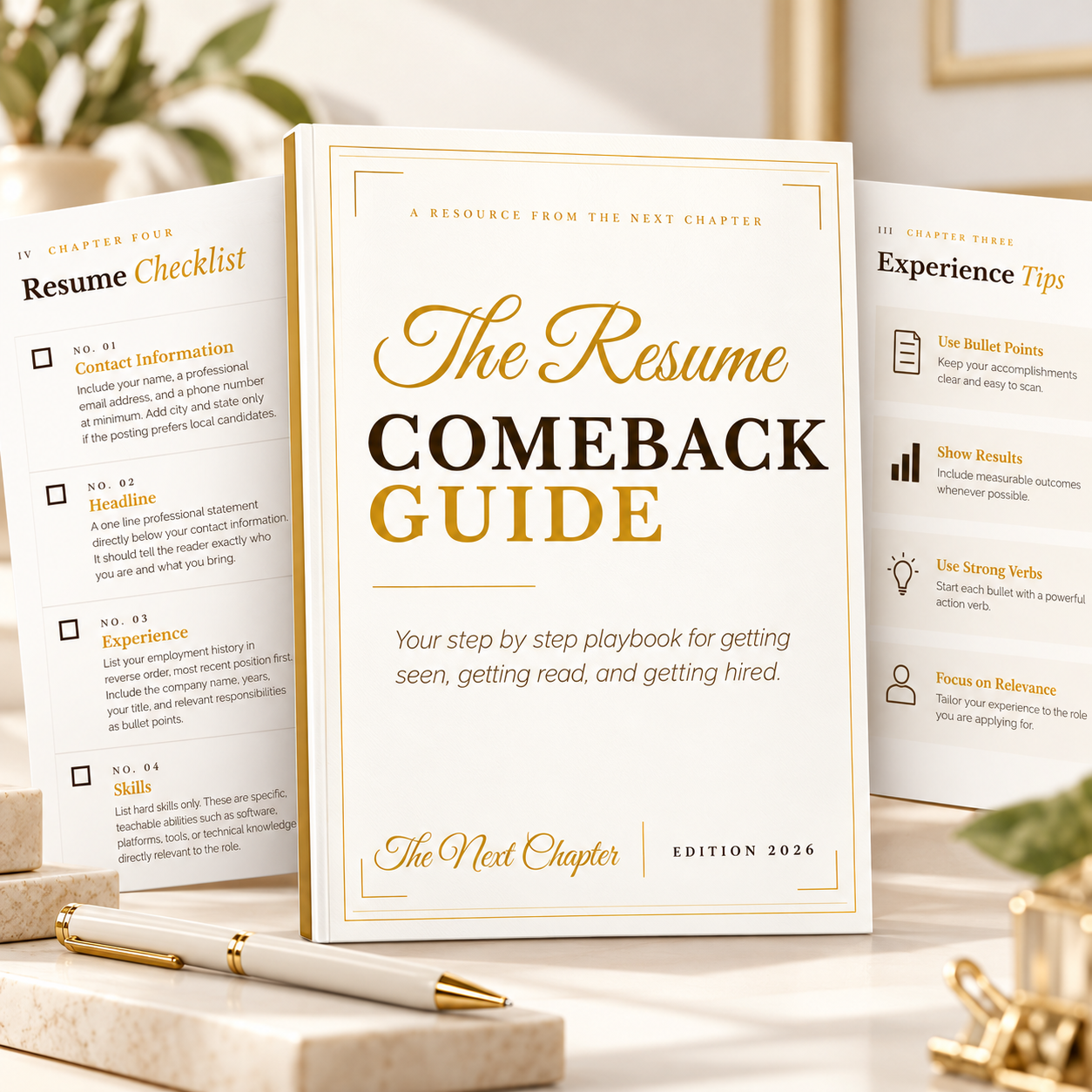
If you want a step by step way to do all of this, The Next Chapter has a free guide called The Resume Comeback Guide. It was written from the HR side of the hiring table, and it walks you through ATS ready formats, how to use keywords so they read naturally, and how to use AI prompts without sounding like everyone else. There is a checklist inside too, so you can look your resume over before you hit submit. It is free, it is yours whenever you want it, and there is no pressure either way.
The Next Chapter. A career development program of The 1st 28 Foundation. Built for women who are ready to move but need a clear path forward. Over 17 years of HR experience behind every resource we create.